
The Cure, the Fix, the Program for Reversing Type 2 Diabetes
Diabetes Progresses when your spot sugar is above 7.0 mmol/L (125 mg/dl)
Diabetes Regresses when your spot sugar is below 6.0 mmol/L (108 mg/dl)
Here is the process I went through with this disease to reach my present understanding of how to fix it.
Firstly I read the Newcastle Diabetes Reversal paper and imagined that simply by losing a lot of weight I could reverse my condition. I believed Prof Taylor's assertion that diabetes is caused by insulin resistance which is caused by a fat build up in the liver. So I went from a BMI of 26.4 (weight of 176 lbs) to a BMI of 21.0 (140 lbs) in 12 weeks. That improved my condition in that I could almost pass a 50% OGTT but I was still very much diabetic. I then wasted 3 months getting even thinner to no avail.
Then I read that insulin resistance is caused by having the wrong type of fat in one's diet. Too much Omega6 and not enough Omega3. So I went on a Paleo diet for 3 months. I ate boat loads of Omega3 and as little as possible Omega6 in order to restore my muscle cell membranes to a non insulin resistant condition. That had absolutely no measurable effect whatsoever. In fact saturated fat produces more insulin resistance than does Omega6 I now understand.
Then one day I read a paper showing that the average person loses 10% of his muscle mass between the ages of 20 and 50 and a further 30% of it between the ages of 50 and 80. I had already read a paper explaining that around 100 gm of blood sugar is stored as glycogen in the liver and around 500 grams of blood sugar is stored as glycogen in the muscles. The muscle glycogen is only usable by the muscles which are storing it whereas the liver glycogen is used to ensure that the brain gets enough sugar.
I already knew that diabetes is a progressive disease getting worse as one gets older and I wondered whether this losing muscle was a part of it since the muscles are our glycogen warehouse. I found other papers showing that insulin resistance (by which is meant apparent insulin resistance) is inversely proportional to muscle mass. In other words it would go up by around 10% between the ages of 20 and 50 and by around 30% between the ages of 50 and 80. Then the penny dropped. If a normal person's muscle mass decreases by 40% between 20 and 80 and his apparent insulin resistance increases by the same amount then since the muscles are storing the glycogen and since the insulin is the fork lift truck in the glycogen warehouse there was no deterioration in the fork lift truck performance between 20 and 80 there was just 40% less warehouse capacity because 40% of the muscles had gone. I mean it is not easy for insulin to force glucose into muscle that no longer exists!
So I realised that there is no variation at all in true insulin resistance between the ages of 20 and 80 in normal people. So Diabetes does not start with insulin resistance. 33% of normal people become diabetic after the age of 65. So type 2 diabetes is caused not by insulin resistance but by a lack of warehouse space, a lack of glycogen storage capacity. Your sugar battery is full up, it can no longer take the charge its gets from a meal and distribute it up until the next meal. It starts with a lack of glycogen storage capacity. But this then leads to too much sugar being around which somehow causes the insulin resistance. Perhaps the little capillaries in the muscles get all sugared up? Actually everywhere gets sugared up so that even when you have got your blood sugar back to normal you heal very slowly because even low sugar blood finds it hard to get through your sugared up tiny capillaries.
With this new understanding I could see why very fat or only slightly diabetic people could reverse their diabetes by losing weight. Imagine that your ideal weight is 150lb but your present body weight is 50% more at 225lb. Then crudely speaking you are eating 50% more than you would eat at 150lb. So you need to store 50% more sugar in your glycogen warehouse than you would need to store at 150lb. Imagine that your glycogen warehouse, your glucose battery, your muscles, can store 120% of what you would eat at 150lb to maintain your weight. Then you would be non diabetic at 150lb. But at 225 lb you eat 50% more and so need to store 150% of the glycogen that you would be storing at 150lb. Now your battery can only store 120% of your ideal weight glucose production. Therefore you are diabetic.
Likewise with gestational diabetes. Before you are pregnant your sugar battery can store perhaps 120% of your glucose consumption. So you are fine. But during your pregnancy you eat for two, perhaps your food consumption goes up by 33%. So again it exceeds what your glucose battery can store and so you become diabetic until the baby is delivered at which point your battery is once again able to cope.
Likewise with bariatric surgery - gastric band surgery. This forces the patient to more than halve his glucose production from food. Therefore his glycogen storage capacity may well by sufficient under the new regime but insufficient when he was eating for a 250lb person!!
When you look at the Newcastle Diabetes Reversal results you see that all the subjects of the trial were fat with a BMI of 33.6 and were only mildly diabetic in the first place with a blood sugar of 9.2 mmol/l (mine was 23). So they were selected to be good candidates for diet only reversal. The results therefore do not apply if you are not very overweight or if you are more than mildly diabetic as I found out to my cost.
Losing weight only fixes type 2 diabetes in obese people who are only mildly diabetic
So once I had realised that glycogen storage space in muscle was the issue I went about trying to clear some space so that I would cease being diabetic. I walked and walked and walked on my treadmill until my feet fell off. I was doing around 10 miles per day. This had the effect of ending all my neuralgia for a few hours after each exercise bout which was a new and wonderful experience for me especially as I have testicular neuralgia which I will not trouble you with further details of save to say that if that does not motivate me to fix my diabetes nothing will! (Actually it was a very bad thrush infection in that area - caused by diabetes - which I mistook for testicular neuralgia. It would give me more pain down there when my sugar went up because sugar is what the thrush=candida, yeast=fungus, eats! )
Also I could pass a 50% OGTT if I walked before the test to create enough storage space for the glycogen from 33 gm of glucose in half a bottle of Lucozade. So you can carry forward the storage space that you clear. This incidentally proves that the glycogen storage capacity model for diabetes is correct and the insulin resistance model is incorrect because walking for 45 minutes will not change your insulin resistance but it will clear glycogen storage space in your leg muscles and that is how you pass the OGTT. You are permitted to exercise before an OGTT but not during it because the medical community does not recognize that lack of glycogen storage capacity is the cause of this disease.
So I thought I had the cure and walked my little feet off. But every time I cleared some storage space it would just get filled up again. By now my muscles were in better shape than they were when I was 21. I am now 56 and was walking 9-10 miles per day and doing 100 sit ups per day. But I was still only breaking even with type 2. I was not winning.
Then I noticed that even if I ate nothing for the whole day, my blood sugar would go up and up from the minute I got out of bed. It did not go up much in bed thank God! I realised that my liver was over producing glucose the whole time. The medical community recognize this as a feature of diabetes but they put it down to a malfunction in the liver. I do not see how that can be the case because prior to my diagnosis I was eating one chocolate bar a day, one quarter of a chocolate cake a day, drinking one litre of fruit juice a day, stuffing my face with carbs and spending all day sitting down in front of a computer doing absolutely no exercise at all. This awful modern western lifestyle obviously caused my diabetes. But during the 30 years that I was doing this my body had plenty of blood sugar without my liver having to produce any. So I do not believe that my liver was malfunctioning or over producing glucose prior to my diagnosis. So the liver was not the cause. So there is another reason why it is making so much sugar all day long after my diagnosis even when I eat nothing.
Well the only organ that absolutely needs sugar and cannot store it is the brain. When diabetics go hypo (on drugs or on insulin) it is the brain that conks out not the muscles or any other organ. So it is the brain that is demanding sugar from the liver on a very low carb diet. So in my case it is plainly demanding too much sugar. Yes its addiction is exposed by my ultra low carb diet - or perhaps caused by it. The thing that had changed since my diagnosis was my diet. The brain was telling my liver to compensate for that.
My brain has become subconsciously addicted to blood sugar during my 30 year sedentary carb fest prior to diagnosis. The human brain is an addictive mechanism. Why would it not become addicted? I now understand that there is nothing wrong with my liver. My trouble is that my brain is telling my liver to make sugar all day long. I am on a 20 gram per day max carbs diet. I eat no sugar and virtually no carb. I never have to brush my teeth any more (although I do about once a week) and yet my blood is full of sugar if I do not walk or swim or exercise it off.
So now I had finally got there - or so I thought. My brain was addicted to a blood sugar level of 7 or 8 or 9 mmol/L (125, 144, 162 mg/dl) or worse and it tells the liver to produce sugar until it gets what it wants. In the meantime the pancreas is saying wooah! I had better make some insulin - the sugar is too high. So the pancreas is making the insulin which is perfectly good stuff and forces the blood sugar into all the available muscle warehousing space. But when all my muscles are full the brain is still telling the liver to make sugar and there is the problem. So I could have the muscles of Arnold Schwarzenegger but I would still be diabetic because my liver would just fill up their entire storage capacity and then produce more sugar until the brain was satisfied. But when is an addict ever satisfied?
I have never taken any diabetic drugs - mainly because the SGLT2 inhibitors were not available when I was diagnosed and Metformin which was a possibility can cause hypoglycemia with a lot of exercise.
Metformin primarily restricts hepatic glucose production - it reduces liver sugar production from protein - a process called gluco-neo-genesis. The trouble with this is that if you then do some sugar reducing exercise and get to the point where your blood sugar is too low for your brain to function, the brain will desperately tell your liver to make more sugar and your liver may not be able to do it. So you will go into a hypo - which is very dangerous.
In any event you can achieve better results than Metformin through diet and exercise alone. I have a friend (Ian) who is diabetic and has been on Metformin for 3 years. I finally persuaded him to go to the gym and after 16 trips to the gym over a period of 3 month his HbA1c went down from 7.2% to 6%. The instructor at the gym told him that several people there stopped taking Metformin after they had done some regular exercise.
The best way to handle this is to do exercise in the day before you take the Metformin. Better still keep up the exercise and ditch the drugs - see the testimonials page.
The SGLT2 inhibitors are different. They stop the Kidneys re-aborbing glucose from the urine back into the blood. So you end up urinating glucose. This will not cause a hypo. It may cause a bacterial (enterococcus) or fungal/yeast (candida/thrush) urinary tract infection (UTI). But this is not a direct side effect of the drug. It is a side effect of the effect of the drug which is to load your urine with sugar which makes it a nice attractive meal for bacteria and fungi such as Thrush or Ringworm (Athletes Foot).
I have not yet tried Forxiga (AtraZeneca's SGLT2 inhibitor). But I think that drug enhanced exercise and diet is now a real possibility with these new drugs which do not cause hypos. http://www.forxiga.eu/clinical-efficacy/consistent-reductions-over-24-weeks
The trouble with Metformin alone or even with Metformin and Forxiga alone is that although they significantly reduce your HbA1c (long term blood sugar) in the first 6 months, the effect eventually wears off because they do not reduce your sugar enough to put diabetes into regression - see http://www.forxiga.eu/clinical-efficacy/sustained-efficacy-up-to-4-years/4-years-forxiga-metformin-vs-su-metformin
So after 4 years (208 weeks) you are worse than when you started with Glipizide+Metformin and you are almost back where you started with the latest Forxiga+Metformin. These are the results obtained from a constant dosage of Metformin and Forxiga. If you increase the dosage then you can maintain a 1% decrease in HbA1c for 3 years - see http://www.nutritionandmetabolism.com/content/7/1/83.

The above is the best that Metformin can do. But it is not enough to put diabetes into regression. Even the best sugar level candidate (at the bottom of the vertical lines) ended up with an HbA1c that was 5.3% after 12 months, which was fine, but then it increased to 5.7% after 36 months (even with an increased metformin dose).
So the best drugs will slow down the rate of progression of diabetes compared with no drugs. But the disease will still progress as will your symptoms and your neuralgia - to the point where statistically you die 10 years earlier than normal due to diabetic complications.
The only way to keep your HbA1c below 5.5% indefinitely is to use a very low carb diet and carb burning exercise either by themselves or in addition to drug therapy.
Diabetes Progresses when your spot sugar is above 7.0 mmol/L (126 mg/dl),
(HbA1c above 6%)
Diabetes Regresses when your spot sugar is below 6.0 mmol/L (108 mg/dl), (HbA1c
below 5.4%)
Essentially a blood sugar of more than 7.0 mmol/L will sugarize you and a blood sugar of less than 6.0 mmol/L will desugarize you. No diabetic drug therapy can keep your spot sugar below 6.0 mmol/L (108mg/dl). Hence no drug therapy can cure diabetes. But diet and exercise can. And with the new SGLT2 inhibitors, drug assisted diet and exercise will be able to keep your spot sugar below 6.0 mmol/L and your HbA1c below 5.4% without having to do too much walking and without running the risk of hypos. Just make sure you have some good anti thrush cream for possible fungal infections and get your doctor to test your urine regularly for bacterial UTIs.
Every morning I wake up, get out of bed and then my liver tries to murder me with sugar. I retaliate against this with diet and exercise. I used to eat no sugar and only 20 grams of carb per day. I now eat no sugar and 40 grams of carb per day to get a better variation of food intake and cut down a little on the gluconeogenesis. I used to have to walk for around 9 miles per day on my treadmill for good sugar - now (July 2014) it is 6 miles per day. So there is a war between my liver and my muscles and between my sub conscious addicted sugarholic brain and my conscious informed logical brain. You can win this war using only the muscles in your legs.
Here is the graph that says it all from a paper in Kuwait with a large sample of obese subjects both diabetic and non diabetic - see Effect of low-calorie versus low-carbohydrate ketogenic diet in type 2 diabetes by Talib A. Hussain, et al Unfortunately the full text is paid for as of 2014 August1. But it is nicely presented in the 12 pieces of evidence for low carb diets being the default treatment for Diabetes paper - see http://www.nutritionjrnl.com/article/S0899-9007(14)00332-3/fulltext which is free. The diabetics were in general on various medications.
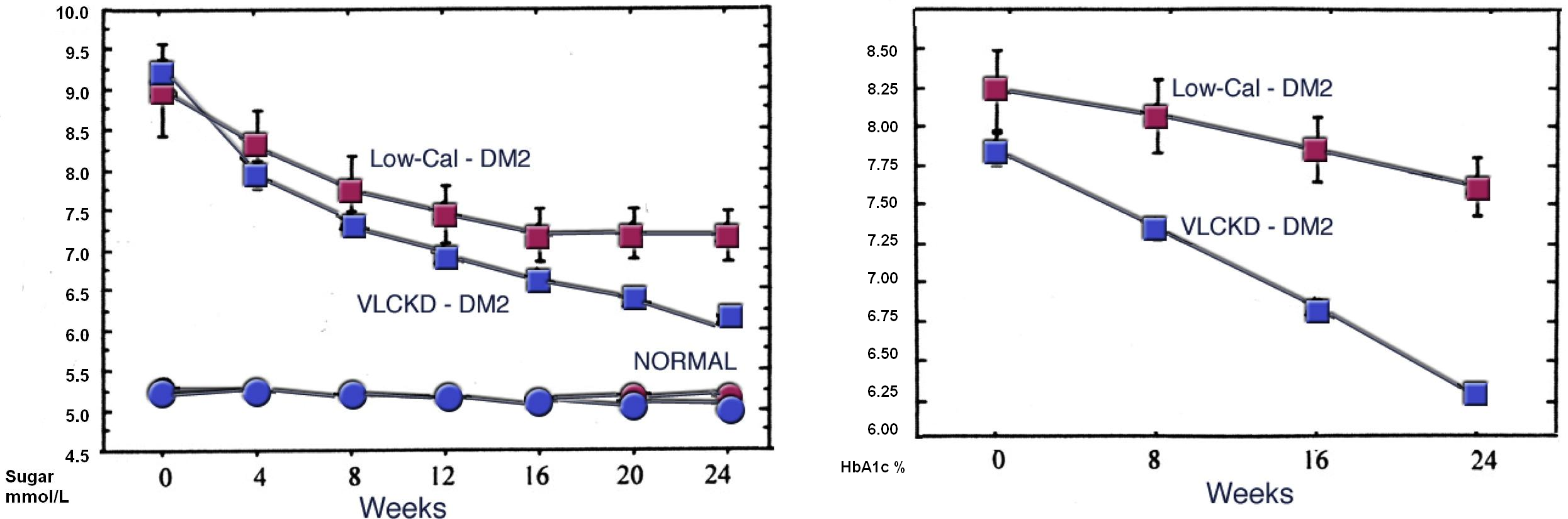
The results above are fantastic. It looks like if the treatment continued for another 8 weeks then everyone on the VLCKD (Very Low Carb Ketogenic Diet) would be cured. But bear in mind that these people were obese with a BMI of around 39 to start with and were not too badly diabetic and lost on average 11 kgs in the 24 week period and were on diabetic medication too. However clearly low carb is better than low calorie. So now we can state clearly what Diabetes is all about...
Diabetics are carboholics who have overloaded and damaged their carb metabolism. Hence the best thing to do is to eat fat instead. Now you might think you will get a heart attack from the fat rather than from the diabetes but you would be wrong. Eating carbs causes more cardio vascular trouble than eating fat - however counter intuitive that may seem. I eat fat all day and my blood lipids and cholesterol just get better and better- again see http://www.nutritionjrnl.com/article/S0899-9007(14)00332-3/fulltext and for a consumer version see http://www.diabetes.co.uk/news/2014/jul/researchers-recommend-carb-restriction-as-primary-method-of-diabetes-control-91152031.html
Finally in the test some of those on the VLCKD halved their diabetic medications in the latter stages of the testing period (because they were doing so well). So plainly a low carb diet can be added to medication for a greater effect. The same is also true of exercise.
Here is the 10 point plan...
Consult your diabetic doctor before you go on this diet/exercise regime!
For diabetics I still recommend the work of Dr Eric Westman at Duke University North Carolina (20 carb grams per day), whose work is related to that of Dr Bernstein (30 carb grams per day) see http://www.diabetesdaily.com/voices/2010/03/interview-dr-bernstein-on-low-carb-diets-treatments-politics/ and see http://lowcarbdiets.about.com/od/bernsteinsdiabetesdiet/p/bernsteinintro.htm. Low carbohydrate diets began with the Atkins diet - see http://en.wikipedia.org/wiki/Atkins_diet
Ultra low carb diets (less than 50 carb grams per day) can result in muscle loss which causes apparent insulin resistance and they can result in increased gluconeogenesis and cause insulin resistance as a cerebral protection mechanism (the brain panics a bit and tells your muscle cells leave what little sugar we have for me!) But extensive research at the university of Oxford over 10 years with thousands of participants has shown that diet however fatty or carby ends up having little effect on your insulin resistance. The body is just amazingly adaptive to its circumstances.
We presently therefore recommend a 40-50 carb gram per day diet in order to have a bit of variation in what we can eat.
1. The diet must be low carb to limit blood sugar, but have enough carb to enable sensible nutrition - so 40 carb grams per day. This will give the pancreas a Sabbath from excess glucose metabolising, to enable it to recover. The body normally recovers if it is given a holiday just as we ourselves do. Type 2 diabetics produce loads of insulin all the time but it has less than its normal effect due to both insulin resistance and a lack of glycogen storage capacity. So the pancreas has been working overtime for decades! It needs a break.
Normal diets are 40% carb, 30%
protein and 30% fat by calorie content.
This equates to 48% carb, 36% protein and 16% fat by grams.
There is a brilliant gram ratio to calorie ratio calculator at http://www.freedieting.com/tools/nutrient_calculator.htm
Very low carb diets are considered to be lower than 10% carb, 45% protein and 45%
fat by calorie content.
This equates to 13% carb, 60% protein, 27% fat by grams.
We are recommending an ultra low carb diet as follows:
8% carb, 46%
protein, 46% fat by calorie content (2000 kcals).
40 gm carb, 230 gm protein, 102 gm fat per day
11% carb , 62% protein, 28% fat by gram weight (fat has 2¼x the calories per
gram of carb and protein)
2. Do not eat any individual food which has more than 10% carb content by gram weight. So no rice, no potatoes, no pasta, no pizza, no noodles, no grains, no grain based bread, no wheat, no barley, no rye, no oats, no corn, no maize, no millet, no doughnuts, no cakes, no pastries, no biscuits.
3. To avoid gluconeogenesis of protein - do not eat thinly sliced or old meat or cheap hamburgers. The worst possible meat is out of date mince (in date good quality mince is fine). The liver will take one look at that and say I am not going to build any body parts from this garbage - melt it down for sugar - its neoglucogenesis for you! Also eat the whole nut rather than nut butter (ideally). The more structure the protein has the less neoglucogenesis it will suffer.
4. High fish and fish oils because these protect against the damage done by animal fats - see http://en.wikipedia.org/wiki/Insulin_resistance. They provide Omega 3 fat to counterbalance the Omega 6 polyunsaturated and Omega 9 monounsaturated fats and saturated fats in land animals. Have at least one fish meal every other day. Be Paleolithic and Mediterranean! Take 4 grams of EPA/DHA Omega3 oil capsules per day.
5. 100 grams of raw vegetables per day. Fine beans, carrots, brocolli spears, radishes, onions, spring onions, salads, cabbage.
6. Replace roast or mash potatoes with carrots and swedes and turnips. Replace potato fries with fried onions - mmmmm. Fry everything in olive oil not sunflower oil or corn oil.
7. High Fibre because this reduces insulin resistance and helps health in general and improves bowel movements and slows blood sugar absorption.
8. Take Vitamin C supplements, cod liver oil, salmon fish oil, omega 3 supplements.
9. NO SNACKING! NO SNACKING! Take Cinnamon from day one if it helps. It certainly can help with neuralgia. One teaspoon per day is sufficient - but every day. Just have a teaspoon of cinnamon in your tea rather than sugar. Or rather make a tea from a teaspoon of cinnamon instead of the tea bag. Remember what Mary Poppins said...
Just a spoonful of cinnamon helps blood sugar go down, blood sugar go
down, blood sugar go down.
Just a spoonful of cinnamon helps blood sugar go down, in the most delightful
way!
10. Most importantly of all, GET A SOFT TREADMILL ... GET A SOFT TREADMILL. Get the best impact absorbing trainers and the best impact absorbing insoles (Sorbothane and Noene) and follow the exercise routine below. WALK THE SUGAR DOWN AFTER EVERY MEAL!!
Whatever you do watch these two videos. They will change your view on diets...
Dr Eric Westman Ketogenic Diet video http://www.youtube.com/watch?v=dSLf4bzAyOM
Dr Mercola Diabetes sermon http://www.youtube.com/watch?v=pXE4aVIJXIw
Forks Over Knives documentary: www.forksoverknives.com
As said above, eating 100 grams of a carb such as potato or bread or rice or pasta or pastry at midday is essentially the same as eating 100gm of sugar at 12:45 pm since the body metabolises all starch into Glucose 6 phosphate (which is sugar). Galactose, Fructose and Lactose based carbs are only half metabolised into Glucose. Sucrose, table sugar, is fully metabolised into Glucose.
There is no point in cutting our sugar from your diet and then eating
carbohydrates which your body will immediately convert into sugar.
Do not eat protein without fat (such as prawns - your liver will make energy
from them through neoglucogenesis - what other choice does it have?). Do not start with day without some fat to teach
the liver to get calories from fat rather than carbs.
This is how it worked at first for a severe diabetic like me. The figures for a 100 carb gram diet are extrapolations from the 40 gram and the 70 gram figures which I have actually tried.
For Normal Eating Times and Proper Carb Burning Exercise (so that you are slightly out of breath and breathing through you mouth not your nose and sweating slightly and not able to sing Whitney Houston during the exercise). Here is what to expect during the first 2 months (HbA1c is a 2-3 month average of glycosylated haemoglobin).
| Treadmill CBE Treatment per day | After Breakfast: After Lunch: After Dinner: Before Bed | HbA1c on a 0-40 carb gram per day diet | 0-40 gm/day Sugar Regulation | HbA1c on an 70 carb gram per day diet | HbA1c on a 100 carb gram per day diet |
| 30 mins (Carb Burning Exercise) | 10: 10: 10: 0 | 7.0% Diabetes in bad progression | Diabetic | 7.5% | 8% |
| 50 mins CBE | 15: 15: 10: 10 | 6.5% Diabetes in progression | Diabetic | 7.0% | 7.5% |
| Metformin typical dose | Metformin | 6.0-7.0% Diabetes in progression | Intolerant/Diabetic | 6.5% | 7.0% |
| 75 mins CBE | 25: 20: 20: 10 | 6.0% Diabetes in slow progression | Glucose Intolerant | 6.5% | 7.0% |
| 100 mins CBE | 30: 30: 25: 15 | 5.75% | Normal but high end of range | 6.0% | 6.35% |
| 120 mins CBE | 35: 35: 30: 20 | 5.5% Diabetes in slow regression | Central Normal | 5.75 | 6.0% |
| 150 mins CBE | 45: 40: 40: 25 | 5.25% Diabetes in regression | Neuralgia reversed | 5.5% | 5.75% |
| 180 mins CBE | 50: 50: 45: 35 | 5.0% Diabetes in good regression | Perfect | 5.25% | 5.5% |
If you eat an extra 30 grams of carb during the day then you make an extra 120 kcal of carb energy. For perfect sugar regulation you will have to burn this off by mouth breathing walking which will burn 50% carb and 50% fat over the entire day. So you will need to do an extra 240 kcal walk to burn 120 kcal of carbs, which will take you around 55 minutes. But taking in more carb reduces the gluconeogenesis a bit so in fact you probably only have to do a further 30 mins of carb burning mouth breathing exercise to fix your sugar. That is how we deduce the 100 carb gram column and how this all works. The crazy thing is that breathless walking for 150 minutes will burn around 650 kcal of which around 375 will be carbs. So for perfect sugar control you effectively burn 94 carb grams every day. Then if you eat say 30 grams of carb during the day, you are still negative by 64 carb grams. But your idiot metabolism will overproduce sugar mainly from ingested protein at a rate which matches this!
If you just walk off your 30 gram carb intake and no more then you would only need to walk for a maximum of 55 mins per day. But doing this is insufficient. The body will overproduce blood sugar for your brain and you will get a high HbA1c and diabetic neuralgia with this low amount of exercise - which is absurd.
So most of your sugar reducing walking will be to absorb your hepatic sugar overproduction from gluconeogenesis of ingested proteins
Why does the liver not simply produce the correct amount of sugar through gluconeogenesis? Why does it make more than you actually need?
The answer must be that either your brain has become carboholic or that the feedback loop telling the liver to stop making sugar does not work properly when you have insulin resistance.
Then after 2 months of at least 2 hours CBE per day things should improve and it should work more like this..
| Treadmill CBE Treatment per day | After Breakfast: After Lunch: After Dinner: Before Bed | HbA1c on a 0-40 carb gram per day diet | 0-40 gm/day Sugar Regulation | HbA1c on a 70 carb gram per day diet | HbA1c
on a 100 carb gram per day diet |
| 30 mins (Carb Burning Exercise) | 10: 10: 10: 0 | 7.0% Diabetes in bad progression | Diabetic | 7.5% | 8% |
| 50 mins CBE | 15: 15: 10: 10 | 6.5% Diabetes in progression | Diabetic | 7.0% | 7.5% |
| Metformin typical dose | Metformin | 6.0-7.0% Diabetes in progression | Intolerant/Diabetic | 6.5% | 7.0% |
| 75 mins CBE | 25: 20: 20: 10 | 6.0% Diabetes in slow progression | Glucose Intolerant | 6.5% | 7.0% |
| 100 mins CBE | 30: 30: 25: 15 | 5.75% | Normal but high end of range | 6.0% | 6.35% |
| 110 mins CBE | 30: 30: 30: 20 | 5.5% Diabetes in slow regression | Central Normal | 5.75% | 6.0% |
| 125 mins CBE | 35: 35: 35: 20 | 5.25% Diabetes in regression | Neuralgia reversed | 5.5% | 5.75% |
| 150 mins CBE | 40: 40: 40: 30 | 5.0% Diabetes in good regression | Perfect | 5.25% | 5.5% |
Then there is a trick we can employ which results in having to walk less. If we eat our dinner late and exercise not long afterwards and then go straight to bed after the exercise then we can skip the before bed routine. This works because sleep or just lying down effectively freezes your blood sugar unless you are really badly diabetic (with a low carb diet and a reasonable amount of exercise you will not be).
| Treadmill CBE Treatment per day | After Breakfast: After Lunch: After Dinner: | HbA1c on a 0-40 carb gram per day diet | 0-40 gm/day Sugar Regulation | HbA1c on a 70 carb gram per day diet | HbA1c
on a 100 carb gram per day diet |
| Metformin typical dose | Metformin | 6.0-7.0% Diabetes in progression | Intolerant/Diabetic | 6.5% | 7.0% |
| 75 mins CBE | 25: 25: 25 | 6.0% Diabetes in slow progression | Glucose Intolerant | 6.5% | 7.0% |
| 90 mins CBE | 30: 30: 30 | 5.5% Diabetes in slow regression | Central Normal | 5.75% | 6.0% |
| 105 mins CBE | 35: 35: 35 | 5.25% Diabetes in regression | Neuralgia reversed | 5.5% | 5.75% |
| 120 mins CBE | 40: 40: 40 | 5.0% Diabetes in good regression | Perfect | 5.25% | 5.5% |
The above recommendations are the optimum use of whatever walking time you can manage in my experience. Moderate intensity exercise such as brisk, that is brisk, walking upon a treadmill at zero incline will burn mainly carbs for the first 30 minutes for a non diabetic person with good sugar levels and thereafter it will burn mainly fat. If you are diabetic and have higher sugar or if you exercise just after a meal then you can go for 40 minutes before you start burning mainly fat. And if you keep increasing the speed of the exercise you can go for 55 minutes before burning mainly fat in my experience.
The table above was deduced from my experience with my less than optimal journey since it took me a long time to learn how to do this. My friend Sami was moderately diabetic on diagnosis with a blood sugar of 13.9 mmol/l (250 mg/dl) and had only been extra thirsty for 2 months and had no diabetic neuralgia. He started the correct diet and exercise program on day 5 after his diagnosis. With him it works more like this...
| Treadmill CBE Treatment per day | After Breakfast: After Lunch: After Dinner: | HbA1c on a 0-40 carb gram per day diet | 0-40 gm/day Sugar Regulation | HbA1c on a 70 carb gram per day diet | HbA1c
on a 100 carb gram per day diet |
| 60 mins CBE | 20: 20: 20 | 5.5% Diabetes in slow regression | Central Normal | 5.75% | 6.0% |
| 75 mins CBE | 25: 25: 25 | 5.25% Diabetes in regression | Neuralgia reversed | 5.5% | 5.75% |
| 90 mins CBE | 30: 30: 30 | 5.0% Diabetes in good regression | Perfect | 5.25% | 5.5% |
As mentioned on the home page his sugar was 5.5 mmol/L (99 mg/dl) in the morning and after every walk by day 18 after diagnosis. So we expect him to be fully cured in the sense that he only has to exercise for an hour per day on a 100 carb gram per day diet by the end of July. And actually he was fully cured on 2014 July 15th. By that time he had morning sugar of 5.2-5.5 mmol/L (94-99 mg/dl) from only walking 50 minutes per day (30 minutes upon a treadmill in his health club and 20 minutes outside) on a 100 carb gram per day diet. So whole cured took him 30 days.
So the amount of exercise that you need to do depends upon how diabetic you were upon diagnosis and what progress you have made since then. I used to have to do 180 minutes per day to have perfect sugar (on a 40 carb gram per day diet). Now I can get perfect sugar on 120 minutes per day. Sami started with 90 minutes per day (on a 70 carb gram per day diet). So the day will come when he can regulate perfectly with less than one hours exercise. And we all should do one hours exercise per day anyway. Well yes, that day came on July 15th 2014!
I make Cinnamon tea as follows.
1. Boil some water and pour it into a cup
2. Add some milk to cool it down a bit
3. Add a teaspoon of good aromatic cinnamon
4. Stir thoroughly for 30 seconds
That is it. No tea bag is needed. Cinnamon has a very nice and strong and actually quite sweet taste of its own. Do not boil the Cinnamon or you will kill some of its power.
If you are working and there is no gym at work then eat a carb light lunch and go for a walk as fast as possible in the vicinity of your office immediately afterwards. Try to find a park or some other soft surface. Or just skip lunch and have a big breakfast.
So what is the best exercise routine to use? I have been researching this and actually doing it now for 15 months and I have finally got there. The amount of carbs you burn is proportional to the amount of oxygen you burn/breath during the exercise because carbs are burnt aerobically with oxygen. So the idea is to be slightly out of breath the whole time. One does not want to be very out of breath because stress will put up your sugar. One does not want to be breathing through the nose and singing Whitney Houston because then you are achieving very little from a carb burning standpoint. The idea is to stretch yourself - but not to stress your self. So find the speed of walking that begins to make you have to breath through your mouth. When I started this in March 2013 the speed was 2.8 mph or 4.5 kph. Then ramp up to that speed in the first 5-10 minutes and keep the speed for half of the workout and add another 0.1 mph or 0.2 kph for the second half. So in the first month my routine should have been the following...
0-1 mins 2.5 mph
1-3 mins 2.6 mph
3-5 mins 2.7 mph
5-25 min 2.8 mph
25-40 mins 2.9 mph
Then you will find as the months go by that you get fitter and can walk faster. You will soon be able to do the above routine without getting out of breath at all. Before getting to that point you should up the speed to the next level to ensure that you are slightly breathless and stretching yourself but not stressing yourself. Here is my present routine as of March 2014.
0-1 mins 2.8 mph
1-2 mins 3.0 mph
2-4 mins 3.2 mph
4-6 mins 3.3 mph
6-8 mins 3.4 mph
8-10 mins 3.5 mph
10-25 mins 3.6 mph
25-40 mins 3.7 mph.
My present slightly out of breath speed is 3.5/3.6 mph. Just make sure that after the 5-10 minute ramp up you have to breath through your mouth and have to work slightly.
If during any stage after the ramp up you find yourself breathing happily through your nose - then you are going too slowly, raise the speed up by one notch. Do not increase the incline that does not help for diabetic exercise.
I initially thought that I could not walk much faster than 3.1 mph comfortably. Actually I discovered (thanks to Fool for you loving no more by Whitesnake) that I can walk at 3.7 mph at a push (6.0 kph). And then thanks to Madonna (Cherish) that I can actually walk at 6.4 kph (4.0 mph). And increasing the speed of the walk has a disproportionately good effect on sugar. If you increase the average speed of you walk by 10% then obviously you burn 10% more energy due to the speed increase. But in addition you burn a larger percentage of Carb and less Fat so this gives you around another 10% (see the graphs below). So increasing the speed of the walk by 10% decreases the time you need to spend walking by around 20%. So as from October 10th I have been using Higher Carb Burning Exercise with an average walking speed of 3.3 mph or more. In order to maximize carb burning and minimize fat burning I used the following routine in October 2013...
4.4 kph for 2-3 mins
4.6 kph for 2-3 mins
4.8 kph for 2-3 mins
5.0 kph for 2-3 mins
5.2 kph for 2-3 mins
5.4 kph for 2-3 mins
5.6 kph for 2-3 mins
5.8 kph for 2-3 mins
24 minutes of the above (8x 3 mins) nails sugar to the floor. So in October I never had to do more than 96 minutes per day. Here is the table for CBE (average walking speed of 3.3 mph (5.2 kph) as best as I can fathom.
In November 2013 I started using this routine...
4.4 kph for 4-6 mins
4.8 kph for 4-6 mins
5.2 kph for 4-6 mins
5.6 kph for 4-6 mins
6.0 kph for 4-6 mins
6.4 kph for 4-6 mins
My December 2013 regime was as follows...
10 minutes after breakfast (staged high intensity glycogen clearing)
3 minute warm up
0-5 mins 4.8 kph
5-15 mins 5.2 kph
15-30 mins 5.6 kph
30-40 mins 6.0 kph
40-45 mins 6.4 kph
Average speed is 5.6 kph. The first time I tried this routine on December27 my sugar went down to 4.3 mmol/l, 77 mg/dl when I had finished it. But really the routine was too fast to be sustainable for me.
20 minutes after Lunch (staged medium intensity sugar reducing)
0-5 mins 4.4 kph
5-10 mins 4.8 kph
10-20 mins 5.2 kph
20-30 mins 5.6 kph
30-35 mins 6.0 kph
35-40 mins 6.4 kph
Average speed is 5.4 kph.
30 minutes after Dinner (staged medium intensity sugar reducing)
0-5 mins 4.4 kph
5-10 mins 4.8 kph
10-25 mins 5.2 kph
25-35 mins 5.6 kph
35-40 mins 6.0 kph
Average speed is 5.25 kph
This is a total of 125 mins walking per day.
It seems that by stepping up the speed with time the body does not have time to get into fat burning mode and so burns more carbs than it wants to. With diabetes, everything you do to try and fix the disease the body reacts against. If you try and burn carbs and it has time to learn what you are doing, it will start burning fat instead - to protect your carb reserves - doh! But by stepping up the speed before it has time to settle down, you force it to burn carbs.
Here is a graph showing blood sugar versus spin bike exercise time for a normal person and for a group of Type 1 diabetics. Inclining the treadmill does not help with Diabetes.

The dotted line is for a normal person. He starts burning fat at the 40 minute point when his blood sugar starts rising. The solid line is for the diabetics who continue to burn carbs and sugar until the 90th minute. This is because if you have high blood sugar then exercise will burn that first. The clearest illustrations I have seen which help us to determine when fat is burnt and when carbs are burnt are these two hand drawn graphs...
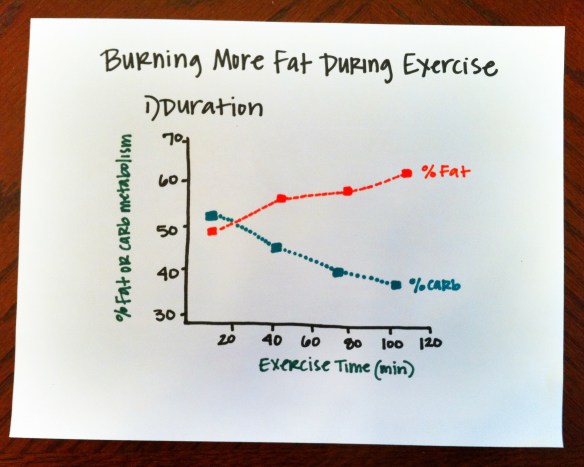

These graphs are designed to help weight loss dieters to burn more fat but we can equally well use them to help diabetics to burn more carb.
However, as can be seen from Type 1 versus no diabetic sugar graph, diabetics burn sugar and carbs for longer. So I suggest a maximum of 60 minutes for any exercise session and a minimum of 15 minutes. If you are on a treadmill then ramp up the speed as you go. Do not keep walking at the same speed for 30 minutes. Start moderately fast and then get faster. That is the optimal way to burn carbs without stressing yourself out too much. Walking at a moderate pace achieves very little for blood sugar after 45 minutes.
However swimming lengths of a pool continuously burns 50% more energy than a moderate walk on a treadmill - http://www.health.harvard.edu/newsweek/Calories-burned-in-30-minutes-of-leisure-and-routine-activities.htm and burns a good percentage of carbs since it is higher intensity. So rather than 45 mins of treadmill CBE one could do 30 minutes of continuous swimming lengths (which I cannot yet manage) or 40 minutes of lengths with a break at each end to get your breath back.
We want to do Carb Burning Exercise to reduce blood sugar and to clear glycogen storage space. The most effective CBE is high intensity exercise but that raises blood sugar because it stresses out the body so I cannot recommend it. I can recommend the following as being great at lowering blood sugar.
1. Slightly out of breath treadmill exercise. Start at a nice moderately fast pace
and increase to a brisk walk as fast as you can reasonably go - hold on to the
rails if necessary. 60 minutes max duration. After meals and before bed (the
best).
2. Lengths of the pool with stops to catch ones breath when needed.
Try to work all your muscle groups. You can certainly beat the liver with your legs alone but give your legs a rest occasionally. I used to have to walk between 9 and 10 miles per day to reverse my neuralgia in August. Now I can do it with 5-6 miles per day in October (that was due to some fast high intensity walking at 6.0 kph after 40 mins of sugar reducing exercise). But less miles on the treadmill and a bit of swimming is a better idea.
Do not worry if you have worse diabetes than me so long as your pancreas is still working. The liver only stores around 100 grams of glycogen - http://www.ncbi.nlm.nih.gov/pmc/articles/PMC3248697/. There is a limit to what it can produce in a day. 100 grams of glycogen is 400 calories. So you may need to do do around 700 calories of mainly carb burning exercise to beat it. But that is the most anyone will have to do I think. However if you eat a lot of protein and no fat, the liver may decide to turn much of that protein into sugar so do eat the fat as well.
http://www.time.com/time/health/article/0,8599,1662683,00.html is a really important paper. It is a big study of Type 2 diabetics. It compares 45 minutes of walking with 45 minutes of weight training with 45 minutes of both together. The results are astonishing and point forward to the cure proposed above.
| Activity | 45 minutes of treadmill walking 3 days/week | 45 minutes of wieght training 3 days/week | 45 mins of Both | The sum of the individual reductions |
| HbA1c reduction | 0.51% | 0.38% | 0.97% | 0.89% |
The whole is plainly greater than the sum of the parts. This shows that exercising all muscle groups gives added bonuses to diabetics over concentrating on only one group. If these guys had done 45 minutes of both 7 days a week rather than 3 then they would have been well on the way to fixing their diabetes!! The American Diabetes Association now bases its exercise recommendation http://www.diabetes.org/for-media/2010/exercise-can-help-tame-type-2.html conservatively (150 mins per week) on this paper.
But you are definitely not going to beat your liver with 150 minutes per week. That will burn 600 kcals around 33% of which is fat. So actually you end up burning 400 kcals of carb per week or 57 kcals per day. Honestly you might as well scatter that around the room. Your liver stores 400 kcals of glycogen which it can convert into sugar at any time. Really you do not want to be conservative when treating Diabetes with exercise! So rather than recommending 150 minutes per week, the Gordon Diabetic Association would recommend 150 minutes per day!
I personally have not really found much benefit in HIT or indeed in anything other than low carb diet and a lot of brisk walking upon a treadmill.
Type 2 Diabetes is a disease caused by being full of sugar due to a lack of exercise and the wrong diet. You are not going to cure it by pussy footing about. A nice 45 minute walk every evening will help but not fix it. A few 30 second bursts of high intensity training every day will help but will not fix it.
You have to grasp the bull by its horns.
1. No sugar at all. Put a spoonful of Cinnamon in your tea rather than sugar. Avoid coffee and only drink a max of two small cups of Decaf per day if you have to. No chocolate. No sugar. No pastries. No cakes. No starch. No bread, pasta, rice, potatoes. No grains. No fruits with more than 10% sugar. No fruit juice - eat the low sugar fruit itself.
2. Only eat food which is less than 10% carb.
3. Ramp up for 5-10 minutes and then do a further 25-50 minutes of brisk walking (for me that is 5.6-5.8 kph) upon a treadmill immediately after every meal. Walk your sugar down to 5.0 mmol/L (90 mg/dl) not 5.5 mmol/L (99mg/dl). You should have to breath through your mouth but do not stress yourself too much. Do not walk for more than 20 minutes at the same speed. go up at notch after 20 minutes or you will start burning mainly fat. Go to bed immediately after your last meal, since lying down freezes your sugar level. If you cannot walk at work then do not eat at work.
4. Do not snack at all. Food is poison. Exercise is the antidote. Administer the antidote immediately after each intake of poison.
Get your muscles in better shape than they were 5 years before you were diagnosed. And get your HbA1c down to as close as possible to 5%. That is the target. I have not got quite there yet (5.3% in December 2013).
That, will certainly put your diabetes into regression. You will be non diabetic as regards fasting sugar after a month or so and clinically non diabetic after 4 months (since the HbA1c is a 3 month average blood sugar). The amount of walking you have to do will depend upon how baldy you have the disease, how far it progressed before you started treating it effectively. And how long you have had it in regression after the effective treatment began. I am still diabetic in the sense that if I stop exercising or eat loads of carbs my sugar figures will become bad again. To fully effect a cure I must continue until I can get perfect sugar with less than one hour of walking per day on a 100 carb gram diet. That will take another 12 months I think (from July 2014).
So to be clear we are recommending 7x as much low intensity sugar reducing exercise as the American Diabetic Association (not 150 minutes a week but 150 minutes per day). And we are recommending 2x as many carb grams as the 20 gram per day ultra low carb diet of Dr Westman.
It has taken me a year to get this right. But most of this time was spent working out what to do rather than actually doing it. I could have become effectively non diabetic in 14 days, and clinically non diabetic in 3½ months (since the glycosylated Haemoglobin measure is effectively a 3 month average). I would also have not had the neuralgia so baldy. But that has gone now thank God.
For a more on the cure please see the conclusion.
As of June 2014, I am doing 150 minutes of brisk walking on a treadmill
ramping up to 5.6 kph (50 minutes after each meal), and then a further 40
minutes of walking around my neighbourhood. A bit of real walking helps me with
my joints.
As of July 2014, I am doing 135 minutes of brisk walking on a treadmill ramping
up to 5.6 kph (45 minutes after each meal), no walking around my neighbourhood -
joints are better.
If your knees are killing you or your feet, then try two huge meals per day rather than 3 smaller meals, then you only need to walk twice. This may not be good for you long term. You need food to keep those muscles going! So just do it for a couple of days to give your knees a bit of a rest.
My latest conclusion is that to a diabetic food is poison and exercise is the antidote. The antidote should be taken immediately after the meal. Do not wait. Fat is not poisonous but carb is 100% poison and protein is 50% poison since the body will treat much of it as carb. To treat type 2 properly you simply have to burn off more sugar than your liver is being told to produce by your addicted brain. Any exercise which burns carbs and does not stress you out too much so that you do not make adrenaline in significant quantity will work in this regard.
If you walk 10% faster then you burn 20% more carbs per unit time and 10% more carbs per unit distance (roughly speaking). So if 40 minutes at 5.5 kph burns off the sugar from your lunch then 32 minutes at 6.0 will achieve the same result. Or you could do 48 minutes at 5.0 kph. The idea therefore is to go as fast as your legs can manage. But be careful...
DO NOT DO HIGH VERY INTENSITY EXERCISE WITH YOUR LEGS (NO JOGGING). It is very counterproductive to do a lot of low and medium intensity walking and then add high intensity with the same muscles. High intensity should only be done in spurts in intervals and not with muscles that are also doing a lot of low or medium intensity work.
If burn off more carbs than you liver can produce in a day then you put exercise in the bank. I have successfully done this. In this condition you will pass any clinical diabetes test. But you are still diabetic, because your bank account will leak. In fact really that is what a type2 diabetic is. It is someone with a leaky exercise bank account. The glycogen storage space cleared by the exercise just becomes filled up with over produced glucose and you eventually go bankrupt in storage space again and return to being a diabetic. I have managed to have a positive exercise balance for 5 days. During those 5 days I could eat a meal without have any kind of post prandial sugar spike. But eventually my liver caught up and bankrupted me again. However the more you do this the less leaky your bank account becomes and that is presently how I believe I can totally cure my diabetes. I think I will need to add swimming to the walking to be able to burn enough carbs to stay positive in glycogen storage space.